TENDER NOTICE: Project Title: Inclusive Civic Action on Reforms for Economic Systems (ICARES)
Job Description
Terms of Reference (TOR)
End of Project Evaluation
Project Title: Inclusive Civic Action on Reforms for
Economic Systems (ICARES)
About Christian Aid
Christian Aid was founded by the British and Irish churches in the aftermath of the Second World
War, in response to the suffering of millions of civilians who had been uprooted from their homes
by the bloodiest conflict the world has seen. A huge amount has changed in the intervening three
quarters of a century: much of it positive. The story of gains in human development, many of them
arising from the rights won by women and girls, is not told often enough.
The prophetic traditions of lament and hope must both be harnessed in the struggle to end poverty.
Poverty has deep structural causes, and action to end it will only have a lasting impact when it
tackles those causes. Yet structural inequality does not reduce people living in poverty to the role of
powerless pawns. In the work of Christian Aid, we are constantly reminded of people’s agency and
ability to change the world for the better, through countless individual acts of courage and
creativity, and through the organized struggle for justice and equality.
Background – Sierra Leone Context:
Most pressing concerns evolve around the economic issues – inflation at 54.2% (Nov), food
and non-food inflation is 59.18%, the Leone is the third weakest currency in the world,
increasing hardship, especially for marginalized women and other excluded groups.
One of the highest levels of gender inequality (181/191 on the UN Gender Inequality
Index)). Financial inclusion rate for women is only 25%, financial illiteracy (78%) amongst
women in the informal sector (UNDP 2023); Limited access to financial services – e.g. bank
accounts, loans, grants.
Poor implementation of existing gender-response economic justice policies (GEWE Act;
local content policy etc). The lack of women’s economic justice is a major barrier to gender
equality and prevents women from participating in governance and economic decisions and
opportunities.
The GEWE Act provides an opportunity to advocate for access to finance for women,
especially marginalized women – based on the provision on access to finance. Shrinking
civic space is a major barrier to advocate for concrete actions for women’s access to
finance.
Project Summary
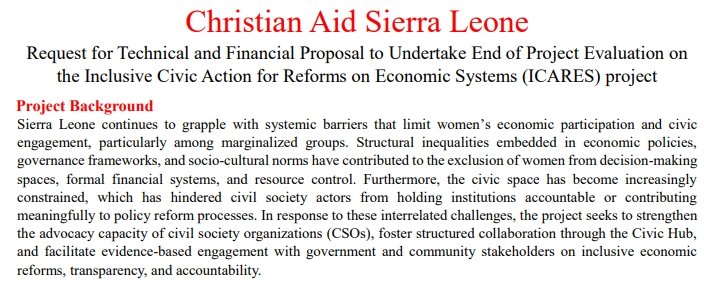
Sierra Leone continues to grapple with systemic barriers that limit women’s economic
participation and civic engagement, particularly among marginalized groups. Structural
inequalities embedded in economic policies, governance frameworks, and socio-cultural
norms have contributed to the exclusion of women from decision-making spaces, formal
financial systems, and resource control. Furthermore, the civic space has become
increasingly constrained, which has hindered civil society actors from holding institutions
accountable or contributing meaningfully to policy reform processes.
In response to these interrelated challenges, the Inclusive Civic Action for Reforms on
Economic Systems (ICARES) project was conceptualized as a strategic initiative. The
project is implemented in partnership between the 50/50 Group and the Inter-Religious
Council of Sierra Leone, with support from Christian Aid. It seeks to strengthen the
advocacy capacity of civil society organizations (CSOs), foster structured collaboration
through the Civic Hub, and facilitate evidence-based engagement with government and
community stakeholders on inclusive economic reforms, transparency, and accountability.
Importantly, these efforts are particularly focused on advancing women’s financial rights
and participation by addressing the political, economic, and social barriers that perpetuate
inequality at multiple levels.
Project Objectives:
Goal/overall objective of the project: Vibrant network of civic society actors (civic hubs)
and faith leaders challenge the social, political and economic systems that restrict civic
space and exacerbate inequality at all levels
The specific result areas (outcomes) include;
1. Confident, powerful and resilient civil society and faith actors and networks are able to
monitor civic space and raise their voice to influence change at all levels
2. National governments, local authorities and international institutions respond by enacting
policies and practices that protect civic space, enable inclusion, participation and
transparency
3. Civil society and faith actors (civic hubs) at all levels challenge restricted civic space,
push for democratic renewal and ensure the protection of human rights defenders
4. Civil society and faith actors create space at a global level for marginalized voices to
shift the debate on global economic architecture.
5. Faith actors at all levels create space through a reparative justice/reparation framing to
reimagine and advocate for a global economic architecture for people and planet.
About the Evaluation:
Ending of March 2026 brings the closure to the project; Inclusive Civic Action on Reforms
for Economic Systems (ICARES) two years project in Sierra Leone through Christian Aid
Sierra Leone (CASL). CASL wishes to commission an independent consultant to conduct an
end of project evaluation exercise.
Purpose:
The purpose of the evaluation is to provide inclusive, good quality, analysed data which can be
used to:
Report against planned outcomes/changes (intended and unintended) in the project Results
Framework or TOC for donor accountability
Ascertain status of project objectives to assess progress of the overall project over the past
two years.
Evaluation Objectives (Outcome Harvesting–Driven):
Identify and capture the outcomes that participants consider most significant/important during
the programme period.
Describe the processes that led to these outcomes and who changed (behaviours, relationships,
policies, practices).
Explain how ICARES started or supported these processes (contribution rather than
attribution).
Generate actionable recommendations and lessons for programming in restricted civic spaces.
Key Evaluation Questions
Who changed (which actors, institutions or relationships)?
What was the observable change in behavior, relationships, policies or practices?
When and where did the change take place?
How did ICARES and change agents contribute to the change (alongside other factors)?
Who benefited or was affected, including any unintended effects?
What factors enabled or constrained the change, and what is the likelihood of sustaining it?
Scope of work
The evaluation exercise will be conducted in an interactive and participatory manner that brings
together diverse project stakeholders (CALS staff, partners – IRC and 50/50 Group, Faith
leaders/Actors, CSOs/civic hub members, project participants, and local authorities) that are
associated with the design, planning and implementation of the project.
The evaluation population study will include representation of the civic hub members, faith leaders,
CSO members. The participants (respondents) will be drawn from a representative sample from
members within all the target groups and districts.
The evaluation exercise is expected to cover 6 key districts including Kenema, Bo Western Area –
rural and urban, Portloko, Bombali and Koinadugu with fair representation of each.
It is expected of the consultant to look at some cross-cutting themes of the project including, gender
and inclusion, accountability, and partnership throughout the evaluation process.
Evaluation Criteria:
The evaluation will follow five integrated phases:
Phase 1: Design & Inception: Inception workshop to refine focus, tools tailored to ICARES
strategies, identification of storytellers, and establishment of consent and safeguarding protocols.
Phase 2: Outcome Harvesting & Story Collection: Desk review; harvesting workshops; community
story circles; key informant interviews with duty-bearers, FBOs/CBOs, and marginalized groups;
linking outcomes to stories.
Phase 3: Substantiation & Validation: Triangulation with independent sources; member checking;
ethical risk review and anonymization where required.
Phase 4: Analysis & Synthesis: Thematic outcome analysis, contribution analysis, narrative
analysis of Stories of Change; integrated answers to evaluation questions.
Phase 5: Learning & Use: Main evaluation report; Stories of Change compendium;
validation/learning workshop; recommendations for future programming.
Existing monitoring data and reported results will be treated as preliminary outcome leads and used
only as prompts where necessary. The harvesting process will prioritize participant-driven accounts
and refine, validate and expand outcomes through substantiation.
Methodology
Given the complex and often non-linear nature of governance and advocacy change, the evaluation
will adopt an Outcome Harvesting (OH) approach complemented by Stories of Change (SoC). OH
will identify, verify and analyze significant changes, while SoC will document lived experiences of
how change happened for women, youth, persons with disabilities, faith actors and community
advocates. This approach focuses on contribution, allows for unintended outcomes to emerge, and
is well-suited to constrained civic spaces.
The Methodology Should Include:
1. Ethics: Christian Aid’ s research ethical protocol must be always followed. The consultant must
fill out the ethics template found here Research ethics risk assessment tool – Christian Aid. This
tool must be included in the inception report.
2. Disaggregation of data: All data, qualitative and quantitative collected through this exercise must
be disaggregated by sex, age, location, and disability status.
3. Data Collection instruments: The consultant will be responsible for developing suitable OH and
SoC tools appropriate to the intervention context. Data collection instruments must be approved by
CA.
Data Management:
The evaluation study should combine a range of techniques (including qualitative and desk review
only of relevant project documents and data), and information sources to allow triangulation of
information and ensure impartiality in assessing the effect of the response. Ensuring data quality
and management is a primary responsibility of the consultant, ranging from data collection, storage,
analysis, reporting and disposal. We require a participatory approach where the consultant engages
relevant key stakeholders.
Ethics and Safeguarding:
Christian Aid is committed to complying with privacy and data protection laws including the Data
Protection Act 2018 (DPA) and the General Data Protection Regulation (GDPR). Christian Aid’s
Data Protection Policy sets out the principles that Christian Aid applies when handling individual’s
personal information. Any consultants offered a contract with Christian Aid is expected to be
GDPR compliant when handling individuals’ personal information as well. Ethical data collection
including confidentiality, consent, thinking about gender and power relations (who is collecting
data from whom), respectful work, health and safety/security is a requirement.
In addition, Christian Aid has a Safeguarding policy that includes Staff Code of Conduct and a
Child Protection Policy which have been developed to ensure the maximum protection of
Programme participants and to clarify the responsibilities of Christian Aid staff, visitors to the
Programme and partner organization, and the standards of behavior expected of them. We have the
responsibility to ensure that any persons hired, used or consulted during the process are made
familiar with the policies and commit to abide by them during execution of this work. Consultants
and team (including enumerators) offered a contract with Christian Aid will be expected to sign the
Safeguarding, Code of Conduct and Child Protection Policies as an appendix to their contract. By
doing so, consultants acknowledge that they have understood the contents of policies and agree to
conduct themselves in accordance with the provisions of these documents.
Deliverables and Timeline
Inception report written in English language submitted electronically. Should include: an
interpretation of the tasks and clearly outlining the approach (target respondents, data
collection strategy, outline of final report, ethical process, quality assurances process etc).
Proposed methodologies should be inclusive and gender sensitive. This will be reviewed
through a call/meeting for discussion and feedback.
Draft evaluation report for review by Christian Aid and partners.
Final report of not more than 30 pages and a 2-page summary of key findings. Some of the
information can be included as annexes to the report.
The report format is predefined (although we are open for the consultant to add additional
information/ perspective not requested).
Information to be presented should be disaggregated by sex, age, and disability where
appropriate and feasible.
The final evaluation report must be delivered by 29 th May 2026.
Proposed Tasks
Task:
Lead person
Proposed
Timeline
# of
Days
Inception meeting with the Project team and sharing
relevant project documents with consultant
CASL Team
Detailed inception report including detailed methodology
and tools, data quality assurance procedures and data
management.
Consultant
Review inception report and draft tools and feedback to
consultant
CASL Team
Final inception report and tools finalized and shared; Consultant
Data collection (OH and SoC) Consultant
Data cleaning, analysis and sharing of first draft report Consultant
CASL team review draft report and feedback to consultant CASL Team
Submit second draft report addressing comments on the
first draft
Consultant
Review second draft report and feedback to consultant CASL Team
Address comments and share final reports (i.e., full
report) Consultant
Total number of Days 60
Quality Assurance:
The consultant is responsible to ensure data validity, consistency, and accuracy and to submit
reports written in good Standard English. If these standards are not met, the consultant will, at
his/her own expense, make the necessary amendments to bring the reports to the required standards.
Consultant Requirements:
The consultant must:
Be able to travel to project locations (as long as it is deemed safe to do so).
Be able to conduct interviews/FGDs in local languages (or have a team member who can do
so) and have fluent written English.
The consultant should possess the following qualities:
Proven knowledge and experience in OH and SoC facilitation
A demonstrated understanding of advocacy, collaboration and government engagement
approaches.
Demonstrated experience and understanding of the project objective areas, and an ability
to discuss them sensitively.
An appreciation and ability to apply strong ethical standards in engaging with
stakeholders, sensitive information, and topics.
An appreciation of ability to engage meaningfully with faith actors, CSOs and the
government.
Demonstrated experience of conducting qualitative data gathering, documentation and
interpretation/analysis
Experience of the International NGO sector and appreciation for the principles of working
in partnership.
Effective communication and facilitation skills.
Demonstrable experience in conducting high quality, credible evaluation study (examples
required) and capacity to work collaboratively with multiple stakeholders.
Christian Aid Roles and Responsibilities
CASL is responsible for full payment of the consultancy work depending on satisfactory
performance
Support in the mobilization of study participants including primary targets and other
stakeholders
Review and approval of all related documents submitted by the consultant including
technical proposal, budget, inception report, data collection tools including questionnaire,
comprehensive and summarized reports, and other related documents.
Payment:
Payment will be made in two (2) tranches:
First instalment of 70% (on consultant fees only whilst the other budgeted items will be paid in full)
upon submission of final inception report and data collection tools of appropriate quality
Second and final payment 30% of consultant fees upon submission of the following:
i. One (1) final evaluation report in English (30 pages)
ii. Soft copy of fully “cleaned” datasets of all collected data at least in Excel or other version
Proposal Development Process:
Financial Information
Financial breakdown (budget) detailing consultant(s) itemized fees, and administrative costs should
be submitted.
Submission of Proposal (Procedure):
The consultant will submit through the email addresses below the technical and financial proposal
and other supporting documents to sierra-leone-info@christian-aid.org copying in
msartie@christian-aid.org and mdimoh@christia-aid.org. Deadline for submissions is Close of
Business hour on the 27 th March 2026.
Address: Christian Aid Sierra Leone, CCSL Compound, 4B King Harman Road, Freetown.
CLICK THE DOCUMENT BELOW TO SEE THE COMPLETE RFQ