Request for Proposals (RFPs) for Impact Assessment of ACF’s Interventions on Food Security in Bonthe and Moyamba districts, Sierra Leone.
Job Description
Request for Proposals (RFPs) for Impact Assessment of ACF’s Interventions on Food Security in Bonthe and Moyamba districts, Sierra Leone.
Action Against Hunger was founded as a non-government organization in 1979 that fights against hunger. Its charter of humanitarian principles-independence, neutrality, non-decimation, free and direct access to victims, professionalism, and transparency–has been part of its identity for 45 years. Its mission is to save lives by eliminating hunger through the prevention, detection and treatment of under-nutrition, particularly during and after emergencies linked to conflicts or natural disaster. Action Contre la Faim focuses its actions on 7 main areas of expertise: Nutrition and health – Mental Health, Psychosocial support – Food Security and Livelihoods – Water, Sanitation and Hygiene – Advocacy – Climate – Research. In 2023, Action Contre Le Faim provided aid to 21 million people in nearly 60 countries worldwide.
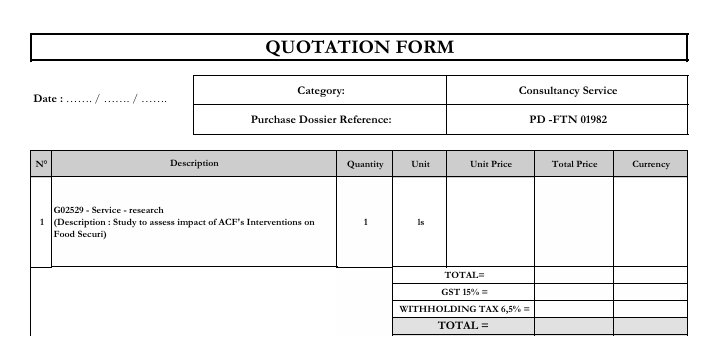
Action Against Hunger is inviting qualified and reputable Consultants/Firms to conduct Impact Assessment of ACF’s Interventions on Food Security in Bonthe and Moyamba districts, Sierra Leone. Detailed description of the required consultancy services can be found on the Terms of Reference ToR attached on the link below: TERMS OF REFERENCE_IMPACT STUDY_rev.docx
Interested consulting firms/organizations are encouraged to express their interests by submitting a detailed Financial and Technical proposal for the required consultancy. Based on the attached Terms of Reference ToR with the following updated and relevant documentations:
- Company/Business Profiles
- Valid Business Registration
- Tax Clearance
- Evidence of experience in previous similar consultancies.
- City/ district council Registration certificate
Submission Instructions: Please submit your Proposals to the
Logistics Department.
- All documents must be submitted in a sealed envelope to our Coordination Office 10 Sall Drive, Cocklebay Freetown, our field offices 1. Bonthe Office: 13 Goba Town Back of UBC Hospital Mattru Jong 2. Falaba Office: 49A Kiridu Road Mongo Township Falaba District
- or via email to logman@sl-actionagainsthunger.org and copy logo-moy@sl-actionagainsthunger.org (with the subject line:
- The deadline for submission is 16th November 2026.
For any inquiries, please contact Email: logman@sl-actionagainsthunger.org Tele: +23272128233.
Action Against Hunger reserves the right to accept or reject any tender that did not conformed to the request and is not bound to award a contract based on this request.
TERMS OF REFERENCE
Impact Assessment of ACF’s Interventions on Food Security in Bonthe and Moyamba Districts, Sierra Leone
FMF, MCA-Nut and NUCAMPS Projects
- BACKGROUND
1.1 ABOUT ACTION AGAINST HUNGER
Action Against Hunger (ACF) is an international humanitarian organization committed to ending world hunger. ACF works to save the lives of malnourished children while providing communities with sustainable access to safe water and long-term solutions to hunger. In Sierra Leone, ACF implements integrated programs addressing nutrition, food security, water, sanitation, and hygiene (WASH), and climate change adaptation.
1.2 ABOUT THE TARGET PROJECTS (FMF, MCA-NUT and NUCAMPS)
Over the period 2022 to present, Action Against Hunger (ACF) has implemented and continues to implement a sequence of interconnected projects in Bonthe District, Sierra Leone, each building upon the lessons and achievements of its predecessor. These projects [First Movers Fund (FMF), the Multi-sectoral Community-led Approach to Nutrition (MCA-Nutrition), ASIF and the Nutrition-Sensitive Climate Change Adaptation and Mitigation Program (NUCAMPS)] collectively represent a sustained commitment to addressing food security, nutrition, climate resilience, and livelihoods in one of Sierra Leone’s most vulnerable districts. Together, they form a coherent portfolio that has progressively scaled up successful approaches, expanded geographic coverage, and deepened community engagement.
The First Movers Fund (FMF) Project was implemented from October 2023 to September 2024 with a budget of €700,000. It targeted 1,800 direct beneficiaries, including 30 Farmer-Based Organizations (FBOs), 1,200 school children, 900 Climate Committee members, and 210 advocacy group members across Jong and Imperri chiefdoms. The project focused on climate change adaptation and mitigation through improved access to quality weather information, ecological management, and sustainable climate-resilient farming practices. Key activities included the installation of an agro-meteorological station, distribution of smartphones configured with the SLMet weather application, provision of climate-resilient agricultural inputs, training of 870 farmers on climate-smart agriculture, establishment of group farms and woodlots, formation of Climate Committees, and implementation of conservation activities in schools. The project successfully established a foundation for climate-resilient livelihoods and community-based environmental governance in the target chiefdoms.
The Multi-sectoral Community-led Approach to Nutrition (MCA-Nutrition) Project was implemented from August 2022 to September 2025, with a Year 3 budget allocation of €1,030,000 as part of a multi-year programme. It reached 8,950 direct beneficiaries, including 3,195 males and 5,763 females, comprising women of reproductive age, caregivers of children under five, 120 Mother Support Groups (MSGs), 46 FBOs, and 30 WASH Committees across Jong, Kpanda Kemoh, and Yawbeko chiefdoms. The project adopted an integrated, community-led approach to address undernutrition through coordinated interventions in health and nutrition, food security and livelihoods, WASH, and mental health and psychosocial support. Major activities included training of 130 health workers on IMAM, establishment and capacitation of 120 MSGs, transition of 46 MSGs into registered FBOs, support to 120 MSGs with VSLAs and agro-inputs (groundnut seeds, vegetables etc) and distribution of cassava processing machines. It also included the construction and rehabilitation of 18 water points and 186 latrines, implementation of Community-Led Total Sanitation, establishment of baby-friendly corners, provision of cash support for caregivers, and nutrition financing analysis.
Notable achievements included an increase in exclusive breastfeeding rates from 53.06% to 57.29%, improvement in women’s dietary diversity from 51.7% to 67.81%, increase in access to safe water from 32.14% to 82.75%, improvement in latrine usage from 43.59% to 70.66%, and certification of seven communities as Open Defecation Free. The project demonstrated that integrated, community-led approaches can deliver measurable improvements in nutrition, WASH, livelihoods, and psychosocial wellbeing.
The NUCAMPS Project, currently being implemented from December 2024 to November 2028, represents the latest and most ambitious phase of ACF’s engagement in Bonthe District. With a total programme budget of €8,000,000, it targets 150 FBOs of 4500 direct beneficiaries across Bonthe, Moyamba, and Falaba districts. In Bonthe, Food Security and Livelihoods component of the project is implemented in Jong, Imperi, Nongoba Bullom, Kpanda Kemoh and Yawbeko Chiefdoms. The project prioritizes women, adolescent girls, smallholder farmers, female-headed households, and marginalized riverine communities. NUCAMPS aims to strengthen resilience to climate change through three interconnected outcomes: increased agricultural productivity and climate resilience of smallholder farmers; enhanced access to dietary diversity, nutrition, WASH, and health services; and catalysed adoption of sustainable energy solutions.
Major activities focusing on food security and livelihoods include provision of climate-resilient agro-inputs to 150 FBOs, procurement and provision of cassava-processing equipment, training of farmers on climate-smart agriculture, installation of three automatic weather stations, and establishment of an Agromet Block in Matru Jong. It also includes establishment of women-led VSLAs, provision of poultry to women FBO members, training on business management and financial literacy, restoration of 40 hectares of mangroves, provision of fuel-efficient stoves, establishment of Climate Committees, and implementation of school conservation activities among others.
These three projects represent a cumulative investment in the resilience and wellbeing of Bonthe District’s most vulnerable communities. The FMF project established the foundation for climate-resilient livelihoods and environmental governance. The MCA-Nutrition project demonstrated the effectiveness of integrated, community-led approaches to addressing undernutrition and improving WASH outcomes. The NUCAMPS project is now scaling up these successful approaches, expanding geographic coverage, and deepening the integration of climate adaptation, nutrition, and sustainable energy solutions. While routine monitoring data exists for each project, there has not been a rigorous, independent assessment of the cumulative impact of ACF’s interventions on food security outcomes in Bonthe District. This impact assessment therefore seeks to generate evidence on the outcomes, lessons learned, and actionable recommendations from ACF’s food security and livelihoods interventions across the FMF, MCA-Nutrition, and NUCAMPS projects (albeit this is still ongoing), with particular focus on the chiefdoms of Imperi, Jong, Kpanda Kemo, and Yawbeko.
1.3 RATIONALE FOR THE IMPACT ASSESSMENT
ACF has been implementing food security and livelihoods interventions in Bonthe and Moyamba Districts over multiple project cycles, including the First Movers’ Fund (FMF), Multi-sectoral Community-led Approach to Nutrition (MCA-NUT) and the current NUCAMPS projects. While routine monitoring data exists for these projects and endline evaluations conducted for the FMF, ASIF and MCA-NUT, there has not been a rigorous, independent assessment of the cumulative impact of ACF’s interventions on food security outcomes in the districts.
This is therefore a one-off study to elicit the impact of ACF’s interventions on food security in Bonthe District especially in Imperi, Jong, Kpanda Kemo and Yawbeko Chiefdoms. The study will mainly target activities of the FMF, ASIF and MCA-Nut. The NUCAMPS will also constitute this study given that it is technically a follow on of the two (FMF and MCA Nut) projects. Overall, this study is intended to generate evidence that will inform ACF’s development efforts in the districts, support learning and accountability, and provide a basis for scaling up successful approaches.
Given the importance and scope of the study, management has decided to engage an external firm with the capacity to conduct a rigorous study to gauge ACF’s impact in Bonthe and Moyamba Districts.
- OBJECTIVES OF THE ASSESSMENT
2.1 Overall Objective
To conduct a rigorous, independent impact assessment of ACF’s food security and livelihoods interventions in Bonthe and Moyamba District, generating evidence on outcomes, identifying lessons learned, and providing actionable recommendations for future programming.
2.2 Specific Objectives
The following are the specific objectives of the study:
- Assess the impact of ACF’s food security interventions on household food security outcomes and coping strategies in Bonthe and Moyamba District, including changes in Food Consumption Score (FCS), reduced Coping Strategy Index (rCSI), and Household Dietary Diversity Score (HDDS).
- Evaluate the effectiveness of ACF’s approaches to improving agricultural productivity, including the provision of climate-resilient inputs, training on climate-smart agriculture, reduction in slash-and-burn, use of climate-smart rice varieties and practices (intercropping) and support to Farmer-Based Organizations (FBOs).
- Assess the contribution of ACF’s interventions to building household resilience to climate shocks, including increase in household incomes through participation in Village Savings and Loan Associations (VSLAs), the adoption of climate-smart practices, and access to weather information.
- Determine the sustainability of ACF’s interventions beyond project cycles, including the continuation of improved practices, functioning of FBOs, and maintenance of assets.
- Identify factors that enable or constrain the effectiveness, sustainability and impact of ACF’s food security interventions, including contextual, programmatic, and community-level factors.
- Generate lessons learned and evidence-based recommendations to inform the design and implementation of future food security and livelihoods programming in Bonthe and Moyamba Districts and beyond.
- Develop compelling, evidence-based infographics that translate assessment findings into accessible visual products for strategic dissemination to national stakeholders, to inform decision-making and advocate for scaled-up investment in food security and climate resilience in Bonthe and Moyamba District.
- SCOPE OF WORK
The consulting firm will be responsible for the following tasks:
3.1 Task 2: Inception, Desk Review, and Stakeholder Engagement
- Review existing project data, relevant background information, reports, and evaluations from ACF’s interventions in Bonthe and Moyamba District.
- Engage with ACF field teams, partner staff (MOPADA, CSSL, SLMet), and other stakeholders to understand the context and intervention history.
- Consult with district authorities, Ministry of Agriculture and Food Security (MAFS) staff, extension agents, and community leaders.
- Develop a detailed assessment methodology, including a rigorous study design.
- Prepare assessment tools (household survey questionnaires, interview guides, observation checklists, scoring matrices).
- Submit an inception report outlining methodology, sampling strategy, tools, and work plan for ACF approval.
3.3 Task 3: Field Data Collection, Analysis and Reporting
- Collect quantitative and qualitative data from a sample frame of about 65 communities in Imperi, Jong, Yawbeko, Kpanda Kemo chiefdoms in Bonthe and about 40 communities in Moyamba District targeted by ACF’s MCA-Nut, First Movers’ Fund (FMF), ASIF and NUCAMPS projects.
- Focus areas include food security indicators, agricultural practices, income sources, asset ownership, and resilience capacities.
- Analyze quantitative and qualitative data using appropriate statistical methods
- Prepare a comprehensive impact assessment report.
- Present findings to ACF and project partners in a validation workshop.
- Provide actionable recommendations for future programming.
- Submit all datasets and analysis files.
- DURATION OF THE ASSIGNMENT
The overall assignment is scheduled for 40 working days. This will be executed within November to December 2026. The final report should be submitted by 15 December 2026.
- DELIVERABLES
The consulting firm/consultant shall deliver the following:
- Inception Report: This will include a detailed methodology and work plan, data collection tools (questionnaires, guides, and checklists), sampling strategy, size, and timeline; to be submitted within 5 working days of contract signing.
- Draft Impact Assessment Report: This will include relevant sections aligning with most of those in the final report below.
- Validation Workshop: Presentation of findings to ACF and stakeholders before finalization of the report. This will be conducted in Bonthe and Moyamba.
- Final Impact Assessment Report: This will be produced after incorporating ACF feedback on the Draft report. The evaluation report shall follow the following format and be written in English:
- Cover Page;
- Summary Table to follow template provided;
- Table of Contents;
- List of Acronyms;
- Executive Summary must be a standalone summary, describing the intervention, main findings of the evaluation, and conclusions and recommendations. This will be no more than 2 pages in length.
- Background Information;
- Methodology describe the methodology used, provide evidence of triangulation of data and presents limitations to the methodology;
- Findings includes overall assessment of the project against the evaluation criteria, responds to the evaluation questions, all findings are backed up by evidence, cross-cutting issues are mainstreamed and; unintended and unexpected outcomes are also discussed;
- Conclusions are formulated by synthesizing the main findings into statements of merit and worth, judgements are fair, impartial, and consistent with the findings;
- Lessons Learnt and Good Practices present lessons that can be applied elsewhere to improve programme, project or mission performance, outcome, or impact and; identify good practices: successful practices from those lessons which are worthy of replication;
- Recommendations should be as realistic, operational and pragmatic as possible; that is, they should take careful account of the circumstances currently prevailing in the context of the action, and of the resources available to implement it locally. They should follow logically from conclusions, lessons learned and good practices. The report must specify who needs to take what action and when. Recommendations need to be presented by order of priority.
- Annexes should be listed and numbered.
- Infographics on Key Findings of the Assessment: This will be submitted with the Final Report. It will include a suite of 3–5 professionally designed, high-impact infographics synthesizing quantitative and qualitative assessment findings, including key food security indicators, ACF’s impact on target communities, success stories, and actionable recommendations. They should be delivered in print-ready and digital formats, branded in compliance with ACF and Irish Aid guidelines, and tailored for dissemination to national stakeholders for evidence-based advocacy and resource mobilization.
- Datasets and Analysis Files: Cleaned quantitative datasets (Excel or SPSS format), qualitative data transcripts and analysis files to be submitted with the final report.
- Dissemination workshop: Presentation of key findings to national stakeholders in Freetown. This will include sharing of infographics developed as part of this study.
- QUALIFICATIONS OF THE CONSULTING FIRM/CONSULTANT
The following are the key qualifications expected from interested firms/consultants:
- Minimum of 5 years of experience conducting rigorous impact evaluations, food security assessments, or related research in Sierra Leone or the West African region.
- Demonstrated expertise in food security, livelihoods, agriculture, climate change adaptation, and/or nutrition-sensitive programming.
- Proven capacity to design and implement rigorous study designs, including randomized controlled trials (RCTs), quasi-experimental designs, and mixed-methods approaches.
- Demonstrated ability to conduct advanced statistical analysis, including impact estimation methods such as propensity score matching, difference-in-differences, or regression discontinuity.
- Evidence of similar assignments completed especially with INGOs, with references from previous clients (at least three references from comparable assignments).
- Commitment to ethical research practices, including informed consent, data protection, and do-no-harm principles.
- The Lead Consultant must hold at least Master’s degree in Agricultural Economics, Agricultural Extensions, Development Economics, Economics, or related social Sciences. A PhD in these subject areas is highly preferred.
6.3 Additional Requirements for the Firm/Consultant
- Must have a proven record of accomplishment of delivering high-quality reports on time.
- Must be willing to comply with ACF’s safeguarding, anti-fraud, and data protection policies.
- Must have the financial and operational capacity to manage the assignment, including advance financing if required.
- Must not have any conflict of interest with ACF or its partners.
- SUBMISSION REQUIREMENTS
Interested firms should submit the following:
- Technical Proposal (max 10 pages) including: Understanding of the assignment, proposed methodology and study design, work plan and timeline, team composition and CVs of key personnel, sample of previous similar work.
- Financial Proposal (max 2 pages) including: Detailed budget with unit costs, all-inclusive cost (professional fees, travel, accommodation, data collection, etc.)
- Institutional Documents (for Firms): Certificate of registration, tax clearance certificate, city council certificate
- HOW TO APPLY
Interested firms/consultants should submit their proposals by 16th November, 2026 to logman@sl-actionagainsthunger.org, with the subject line: “Impact Assessment – Food Security in Bonthe and Moyamba District”.
CLICK THE DOCUMENT BELOW TO SEE THE COMPLETE RFQ MEAL CONSULTANCY
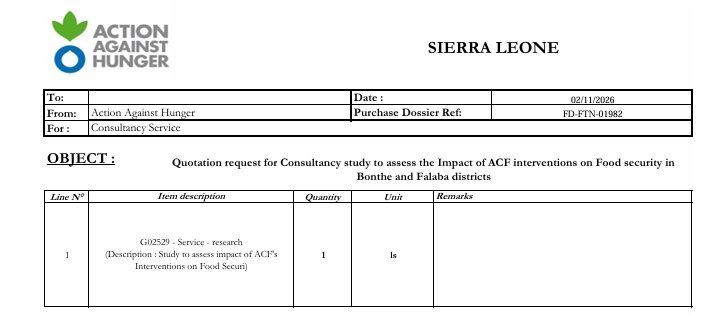
CLICK THE DOCUMENT BELOW TO SEE THE COMPLETE QUOTATON FORM